Whitepaper: More research petabytes per euro. Proven, remanufactured, OCP.
More research petabytes per euro. Proven, remanufactured, OCP. How research and higher education can store AI-era data growth on a fixed grant budget with remanufactured Bryce Canyon storage, up to 11.5 PB per rack.
Research data grows faster than research budgets. Funding is committed years in advance, data center power is fixed, embodied carbon now lands in Scope 3 reporting, and procurement teams field data sovereignty requirements. This whitepaper sets out the technical and financial case for remanufactured Open Compute Project storage in the units that matter to a research institution: usable capacity per dollar, per watt, and per kilogram of CO2.
In this whitepaper:
- Why research data has decoupled from research funding, and what fixed grants, power limits, Scope 3 reporting and data sovereignty mean for storage planning.
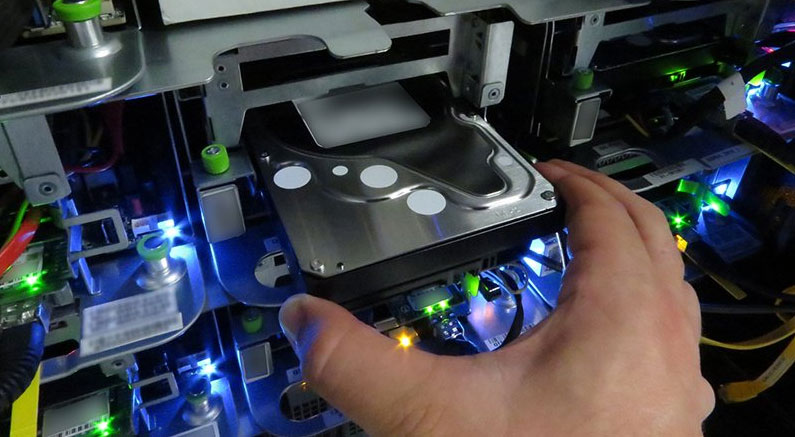
- How a remanufactured rack becomes a warrantied system: disassembly, component testing, part replacement, firmware updates and revalidation against the original specification, with drives provisioned separately.
- The reference platform: OCP Bryce Canyon, 72 drives per system and up to 11.5 PB per rack, including the first performance data measured on remanufactured systems.
- Where it fits and where it does not: data lakes, backup and archive, and HPC scratch tiers versus latency critical flash and frontier interconnect research.
- Assurance you can audit: regional remanufacturing, certifications at the Sims Lifecycle Services production facilities, data sanitization, warranty and support beyond year one.
- Petabyte economics in three ratios, capacity per dollar, per watt and per kilogram of CO2, and a five step evaluation path that ends in a single rack pilot.
Written for research computing leaders, HPC and storage architects, sustainability officers, and the procurement teams behind them.

Read the open chapters
Demand, budgets, carbon, and sovereignty
Demand has decoupled from funding
The need for storage no longer grows in step with research funding. A single high throughput instrument, a genomics core, or an AI training run can produce more data in weeks than a department once gathered in years. Many funders and journals now require that research data be retained and shared openly. The data must be preserved, cataloged, and served long after the originating grant has closed. An institution can meet that requirement through a commercial cloud platform and still cede control of the result: exit costs, a vendor’s terms, and another jurisdiction’s law then apply to its own data. An institution that stores the data on infrastructure it owns meets the same requirement and keeps control of its own data. Research funding grows far more slowly than research data. When the data grows beyond the storage an institution can afford, research slows or stops: teams delete datasets, defer projects, or decline work that would produce more data than they can keep.
Budgets are fixed and inflexible
Research funding is rigid by design. Awards are committed years in advance. Funders ring fence categories, and moving money between capital and operating lines takes negotiation or is simply prohibited. Infrastructure models built around a three-year refresh cycle fit poorly within that structure. The practical requirement is not more budget, but more usable capacity from the budget already held.
Carbon reporting is reaching procurement
Institutions increasingly account for Scope 3 emissions, the category that covers carbon embodied in purchased goods. Servers and storage bought as capital equipment fall under Scope 3 Category 2, capital goods, in the GHG Protocol’s classification. For storage hardware, manufacturing dominates the embodied footprint. Enclosure metals, drive magnets, and semiconductor fabrication carry a carbon cost that is incurred at build time, before the equipment is ever powered on.
A buyer of new hardware books the manufacturing carbon of that hardware to the institution’s account. Hardware whose manufacturing emissions were incurred years ago, by someone else, starts from a different position. The whitepaper tests that claim against the platform engineering, the cost structure, and the assurance model.
Fit is a design decision
Where the economics favor it
The strongest fits follow from Bryce Canyon’s design intent.
- Warm and cold data lakes. Pools of instrument output, simulation results, and shared datasets, where cost per usable petabyte governs the decision and latency does not. This is the tier Meta designed Bryce Canyon to serve, at a scale far beyond any single institution’s.
- Backup, archive, and open data retention. Long horizon storage that funders and open science policy require, evaluated on cost per retained petabyte across multi year periods.
- HPC scratch and capacity tiers. The bulk disk layers behind a parallel file system, where the requirement is petabytes of reliable capacity rather than additional premium flash.
- Second tier cloud and VM hosting. Providers below the hyperscale tier run virtual machines on this class of hardware at low cost.
- High parallelism research computing. Work that needs many cheap nodes in parallel and tolerates modest per-node performance.
Where it does not apply
The platform is a capacity and throughput tier, not a testbed for frontier networking research. Sites testing InfiniBand generations or new Ethernet protocol versions need current silicon that this hardware does not carry. Latency critical flash tiers sit outside the design intent for the same reason. Buyers should include the cost of integration engineering in any comparison. Open OCP hardware is flexible, and it requires integration engineering that a tightly bundled proprietary appliance folds into its price.
The complete whitepaper, including the platform data, the assurance model and the petabyte economics, is available through the form above.
Related
- Why RackRenew? Remanufactured Storage Built on Open Compute
- Remanufactured OCP storage: Bryce Canyon, up to 11.5 PB per rack
- Case study: Brescia’s Data Center Revolution
Also available: Beyond New: Turning Decommissions into Data Center Deployments